Curtains or Blinds for a Narrow Window: How to Choose
Curtains or blinds can reshape a narrow window’s appearance. Compare the wall space, folds and edges to choose a treatment that suits your room.
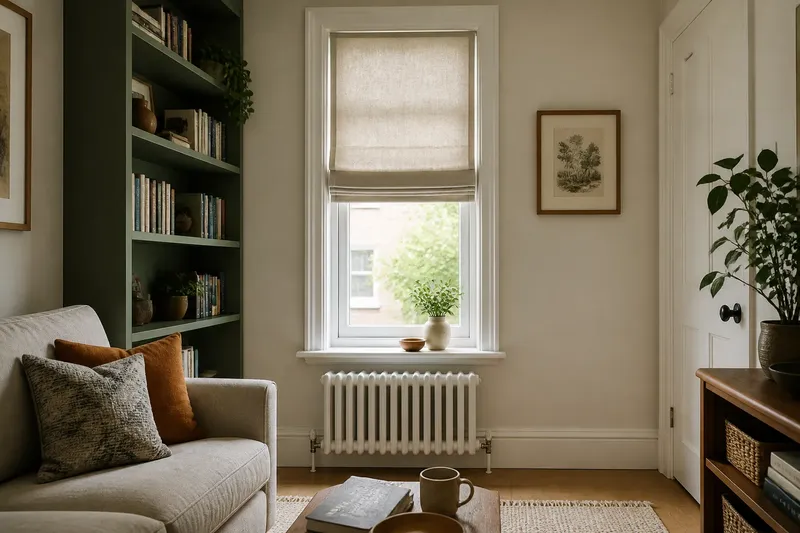
Curtains or blinds can change how a narrow window sits in a room: curtains extend its visual border, while blinds keep attention closer to the frame. If a bookcase crowds one side, that difference can decide whether the window feels framed or squeezed.
Choose by looking at the whole wall, the treatment when open and the room’s existing lines. A blind is not automatically the tidier option, and curtains need not look bulky; fabric, fitting position and available space all matter.
How do curtains or blinds change a narrow window?
Curtains add fabric beyond the glass. A pole extending past the frame lets open panels sit to the sides, revealing more of the window; drawn panels create a broader, layered surface. A higher fitting can draw the eye upwards, while a narrow fitting keeps attention near the frame.
Blinds usually follow the window’s edges and emphasise its shape. A roller blind creates a relatively uninterrupted plane, a Roman blind forms soft folds when raised, and Venetian slats add repeated lines that make the opening feel more segmented.
Think of the treatment as a frame around a picture: a broad border can give the subject presence, but may compete with it. On a narrow wall, the surrounding furniture can matter more than the window alone.
What does the treatment look like when open?
Open curtains still occupy space at the sides as gathered fabric. Check whether that stack would overlap a bookcase, a door swing or a useful patch of wall. A light fabric with restrained fullness may feel less imposing than a heavy, deeply folded panel.
A raised blind clears the window’s sides but leaves a roll, headrail or folded stack at the top. Consider whether that upper edge would sit comfortably beneath a ceiling line, shelf or existing trim. Venetian blinds keep their slats visible even when tilted open, so their repeated lines remain part of the view.
Look at the window from the doorway and the main seat, not only from directly in front of it. The treatment should make sense from the viewpoints used every day.
Which details matter in a crowded room?
Start with the clear wall beside the frame. If both sides have room for panels to gather, curtains can broaden the window without covering the glass. If a radiator, corner or piece of furniture restricts one side, a blind can keep the treatment within the opening.
Then compare the treatment’s visual weight with nearby furnishings. A plain roller can sit quietly beside patterned shelves or upholstery; a Roman blind adds softer folds without sweeping across the wall. Curtains can connect the window to the room’s furnishings, but a strong colour or full pattern may compete with a crowded arrangement.
Say a room has a narrow window, a bookcase tight against its left side and a radiator beneath the sill. The homeowner wants softness but has little room for fabric to stack. They compare a lightly folded Roman blind in a warm tone with a pale roller blind; the Roman option brings more texture, while the roller leaves the window outline quieter. If softness is the priority, the Roman blind is the clearer fit; if visual quiet matters more, the roller is the simpler choice.
How should colour, fabric and pattern guide the choice?
Curtains cover more wall, so their colour and texture have a larger presence. A shade close to the paint lets the folds provide interest without creating a strong border; a contrasting colour makes the window stand out. Judge pattern against the window’s scale and the other patterns visible from the room.
Blinds concentrate colour and pattern within the frame. A plain roller keeps the outline simple, while a patterned Roman blind adds detail and softness. Venetian slats bring their own visual rhythm, even in a restrained colour.
A related tone can help a treatment belong without matching every surface exactly. If the sofa is textured, for instance, a plain fabric in a compatible colour can connect the window to the seating without repeating the same texture.
What should you check before choosing curtains or blinds?
- Check whether the wall on both sides of the frame is clear; if panels can gather without covering furniture or a walkway, consider curtains, but if one side is blocked, compare blinds that stay within the opening.
- Check what remains visible when the treatment is open; if gathered fabric would crowd the window, consider a blind, but if a top roll or headrail would interrupt a shelf or trim, consider curtains.
- Check whether the room needs a broader visual frame; if the window looks lost on a generous wall, consider curtains that extend beyond it, but if the wall is already busy, choose a quieter blind or simpler fabric.
- Check whether the room needs folds or a clean plane; if soft texture would balance hard furniture, compare Roman blinds or curtains, but if repeated detail would add clutter, consider a plain roller.
- Check how colour and pattern sit beside nearby upholstery and shelving; if the window needs emphasis, consider a contrasting treatment, but if those surfaces already draw attention, choose a related plain tone.
- Check the window from the doorway and main seat; if the proposed treatment looks balanced from both, keep it in consideration, but if it dominates one view, compare a less bulky style or quieter finish.
What questions help settle curtains or blinds?
Do curtains make a small window look larger?
They can make it seem broader if the pole extends beyond the frame and the open panels sit clear of the glass. Where side wall is scarce, gathered fabric may instead make the opening feel crowded.
Do blinds make a room look more modern?
A blind often gives the window a defined outline, but that alone does not make a room feel modern. Slats, fabric, colour and surrounding finishes shape the overall impression.
Which treatment keeps the window edge visible?
A blind generally follows the frame and keeps attention on its proportions. Open curtains also reveal the frame, though the fabric at either side remains part of the composition.
Can curtains and blinds be used together?
Yes, when each has a distinct purpose, such as a blind for a contained inner layer and curtains for a wider fabric border. In a crowded room, the combination may add more visual weight than the window needs.
How can you make the final choice?
Compare the treatment’s outline with the room’s fixed features: bookcases, radiators, corners, shelves and doorways. If the main concern is limited space at the sides, curtains or blinds should be judged by where their fabric or hardware sits when open, not only by their appearance when closed.
For this narrow-window decision, choose the option that adds the effect you want without fighting the room’s existing lines. Before fitting anything, check the product’s instructions and, where installation or local requirements are unclear, ask a qualified installer.